On this page
Business-to-business buyer portals in manufacturing carry more operational weight than a typical storefront. Buyers need negotiated catalogs, account-specific pricing, approval workflows, service parts, and reliable order status across long-lived customer relationships.
MACH, which stands for Microservices, API-first, Cloud-native, and Headless, helps because it lets teams compose those capabilities without tying every change to one large release cycle. This guide shows how to design the portal around manufacturing realities, what to decouple first, and which integration choices keep delivery flexible over time.
Why manufacturing buyer portals stress architecture early
In manufacturing, a buyer portal is usually tied to custom pricing, negotiated terms, procurement controls, and fulfillment visibility. A single customer account can include many users, each with different permissions and responsibilities. The portal must represent those realities accurately while staying responsive for daily ordering.
This pressure is one reason teams consider MACH. Instead of binding pricing, product data, customer entitlements, content, and order tracking in one release train, they can evolve these capabilities with clearer boundaries and ownership.
What makes B2B manufacturing different from typical storefront patterns
Use the table below to compare common expectations in manufacturing buyer portals against patterns many teams inherit from simpler commerce setups.
| Dimension | Typical baseline | Manufacturing buyer portal requirement |
|---|---|---|
| Pricing | One price list per region or segment | Account-level contract pricing, volume tiers, quote-to-order, and expiration windows |
| Identity and access | One user equals one shopper profile | Company account hierarchies, delegated administration, and role-specific permissions |
| Checkout | Fast direct purchase | RFQ, approval chains, purchase order references, and split payment terms |
| Catalog | Broad shopper catalog | Entitlement-aware assortments, replacements, compatibility data, and service-part lookup |
| Order lifecycle | Ship confirmation and delivery updates | Multi-step status from ERP, partial shipments, backorders, and account credit checks |
The core architectural implication is straightforward. The portal needs composable capabilities that can change at different speeds without breaking critical buying journeys.
Reference architecture for a flexible buyer portal
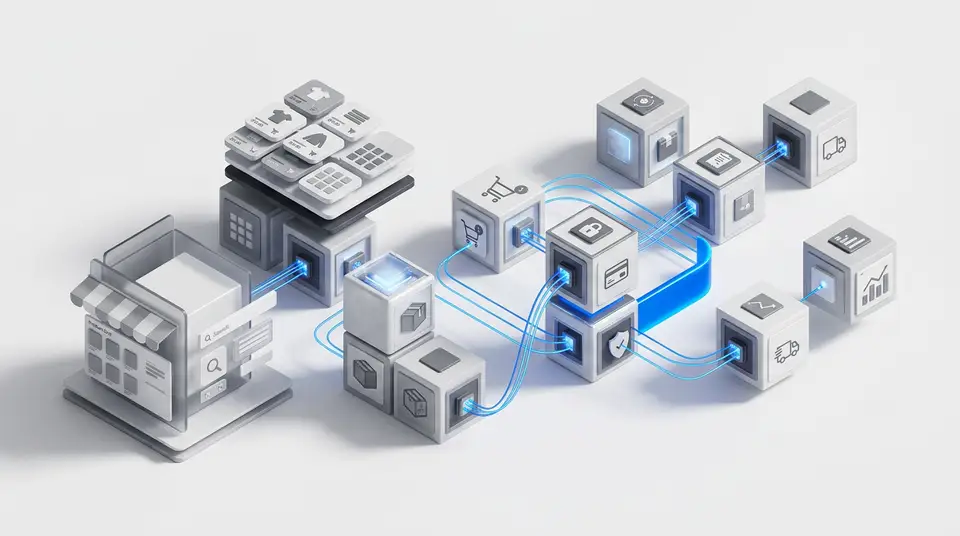
A practical MACH shape for manufacturing buyer portals usually includes:
- Experience layer: A headless front end plus account-aware portal routes for buyers, approvers, and service teams.
- Composition layer: A BFF that assembles account context, pricing, inventory, and content for each request.
- Domain services: Pricing, entitlement, catalog, quote, cart, order, and account services with explicit ownership.
- System integrations: Event and API boundaries to ERP, PIM, CRM, and logistics platforms.
- Platform services: Identity, observability, caching, and policy controls shared across portal journeys.
The goal is not maximum service count. The goal is to keep boundaries legible so teams can deliver pricing, catalog, and account changes independently when business rules shift.
Capability decomposition that maps to manufacturing workflows
Start with business capabilities, not technology layers. In many manufacturing programs, this sequence lowers risk:
- Account and identity context. Model company hierarchies, buyer roles, and approval authority.
- Pricing and entitlement. Expose contract pricing and catalog eligibility through stable interfaces.
- Order orchestration. Connect cart, quote, approvals, and order submission with clear handoffs to ERP.
- Post-order visibility. Add account-level tracking, invoice references, and reorder workflows.
- Self-service expansion. Add returns, warranty requests, and support-case flows without rewriting the core portal.
This ordering works because it anchors the buyer experience in account truth first. Without that foundation, later features become exceptions layered on weak assumptions.
API-first contracts for account-specific commerce
Manufacturing portals rely on account context in nearly every call. That makes API-first discipline essential, especially where commercial terms are sensitive.
Contract design should include:
- Account scope rules: Which account ids a user can act on, and how delegation is represented.
- Price validity semantics: Effective dates, quantity breakpoints, and fallback behavior when contract terms expire.
- Order state vocabulary: A shared state model between portal and ERP so status is interpretable by buyers and internal teams.
- Error and recovery expectations: Which failures are retryable and which require intervention.
- Change policy: How additive updates and breaking changes are announced, tested, and deprecated.
If these details remain implicit, integration drift appears quickly. Teams then spend roadmap capacity reconciling mismatched assumptions instead of shipping buyer-facing improvements.
Data ownership and integration patterns that avoid brittle portals
Manufacturing buyer portals usually sit between multiple systems of record. Clear ownership helps teams prevent hard-to-debug cross-system behavior.
Use the table below as a baseline ownership map.
| Domain concern | Preferred source of truth | Portal integration pattern |
|---|---|---|
| Commercial account terms | ERP or contract service | Read model synchronized by events plus on-demand validation for critical actions |
| Product attributes and media | PIM and content systems | Cached query layer with scheduled and event-driven updates |
| Availability and fulfillment status | ERP and warehouse systems | Bounded-latency lookup with clear freshness indicators in UX |
| Quotes and approval workflows | Dedicated quote and workflow services | Synchronous initiation, asynchronous progression, and auditable state history |
A useful rule is to keep buyer-facing responses fast while making state freshness explicit. Teams can do this with cache windows, timed refresh, and visible timestamps instead of pretending all systems update instantly.
Cloud-native operations for long-running B2B journeys
In B2B manufacturing, many journeys are long-lived. A quote may be revised over days. A large order may ship in phases. Reliability depends on operational discipline as much as code structure.
Priorities that usually pay off early:
- Traceability end to end: Correlate a portal action with downstream events and ERP updates.
- Idempotent processing: Ensure retries do not duplicate quote revisions or order submissions.
- Queue and event hygiene: Monitor lag, retry behavior, and dead-letter flows so partial failures are visible.
- SLO-linked alerting: Tie alerts to buyer outcomes, such as quote response latency or order status freshness.
- Runbooks by business scenario: Document recovery steps for contract sync issues, inventory mismatches, and approval failures.
These practices keep the portal trustworthy during real operational variation, not only during controlled demos.
Headless content and guided buying experiences
Manufacturing portals often blend transactional steps with technical guidance, documentation, and service knowledge. A headless content model helps teams publish these materials across portal surfaces without coupling every content change to core commerce deploys.
Examples that benefit from headless patterns:
- Technical specification blocks tied to account-entitled product views.
- Contextual maintenance content alongside spare-part ordering.
- Role-aware onboarding flows for new buyer users and approvers.
- Regional compliance content that changes independently from checkout logic.
This is where MACH Architecture helps as an operating model. Teams can coordinate shared content structures while maintaining independent release cadence for experience, commerce logic, and back-office integrations.
Implementation roadmap for manufacturing teams
A practical rollout sequence balances value delivery with architecture hardening:
- Launch a narrow vertical slice. Start with one account segment and one high-value journey, such as quote-to-order for service parts.
- Establish contract governance. Add versioning, compatibility checks, and ownership for high-impact interfaces.
- Stabilize account and pricing truth. Make account context and contract pricing deterministic before expanding channels.
- Scale self-service workflows. Add approvals, reorder, and post-order service features by capability.
- Expand to additional channels. Reuse core services for partner portals, field sales tools, or regional buyer experiences.
Each stage should include both product outcomes and operational exit criteria. That keeps decisions grounded when scope pressure increases.
Summary
MACH in manufacturing B2B commerce is less about following a template and more about structuring autonomy around real buyer workflows. Flexible portals emerge when account context, contract pricing, integration ownership, and runtime discipline are treated as first-class architecture concerns.
If your team starts with clear capability boundaries and contract-first integration, the portal can evolve with customer requirements without returning to monolithic release coupling.