On this page
In ecommerce, architecture choices often show up quickly in revenue-related signals: slow checkout, a wrong price on a product page, or search results that lag the catalog feed. Those symptoms make dependencies between systems easy to notice even for stakeholders who do not read code every day.
MACH stands for Microservices, API-first, Cloud-native, and Headless. It describes one way to separate those concerns so product, pricing, and customer experience can evolve without sharing one unavoidable release fate for the entire stack.
This article connects the four pillars to storefronts, operations, and integration work. For pillar definitions and vocabulary, start with MACH Architecture and the primer in related reading; return here when you need a commerce-specific map and decision lens.
Why ecommerce surfaces mounting pressure on architecture
Order-to-cash crosses inventory, pricing, tax, fraud, payments, and ERP handoffs. Omnichannel adds surfaces that must agree on stock, promises, and returns. Composable commerce is the commercial pattern that often sits next to MACH ideas: you purchase or build capabilities as services, connect them with contracts, and treat integration as a first-class product.
None of that makes MACH mandatory. It explains why commerce teams feel coupling early. The practical question is whether your organization can fund clarity at the seams.
How the four pillars read in a commerce context
The letters are the same as in the general primer. The commerce translation is about which customer-visible failure modes you are buying flexibility to address.
Microservices and bounded capabilities
Microservices (the M) encourage capability ownership that matches how the business discusses money. Catalog and PIM stay distinct from cart and checkout. Promotions and pricing do not silently reach into presentation code. OMS can track promises without forcing the storefront to understand warehouse logic in full detail.
Good boundaries shorten blast radius when something breaks. Poor boundaries produce a distributed monolith that still needs a shared release calendar, which combines downsides from both styles.
API-first and the order journey
API-first (the A) means partners, mobile apps, marketplaces, and your own BFF consume the same published operations, not one-off database paths. In commerce, that appears everywhere money or commitments change. Authorize payment, reserve inventory, apply tax, create an order, and expose asynchronous status to the shopper.
Without contract discipline, you get tight coupling expressed as microservice boundaries. REST, GraphQL, events, and vendor APIs are all acceptable seams. The requirement is versioned, testable behavior at those seams.
Cloud-native and demand peaks
Cloud-native (the C) is how you run the system graph when traffic spikes (sales, launches, holidays) or when you rehearse failure. Autoscaling, immutable deploys, infrastructure-as-code, and observability matter more when one slow dependency can stall checkout. Commerce also cares about regional latency, CDN behavior for assets, and cache coherence so PDPs do not contradict the cart.
Running in a cloud account without operational maturity buys little. If you cannot trace a checkout across services or roll back a bad deploy safely, elasticity alone does not fix the risk.
Headless and storefront velocity
Headless (the H) splits authoritative models (products, SKUs, price rules, editorial content) from how each channel renders. Your web stack can move at marketing cadence while the commerce core holds invariants when CMS and commerce APIs stay stable.
B2C teams often want fast experimentation. B2B teams often need account rules, quotes, and approvals layered on the same core. Headless makes multiple experience clusters feasible; it does not remove the need for preview, personalization governance, and accessibility work at the edge.
Typical capabilities in a composable commerce graph
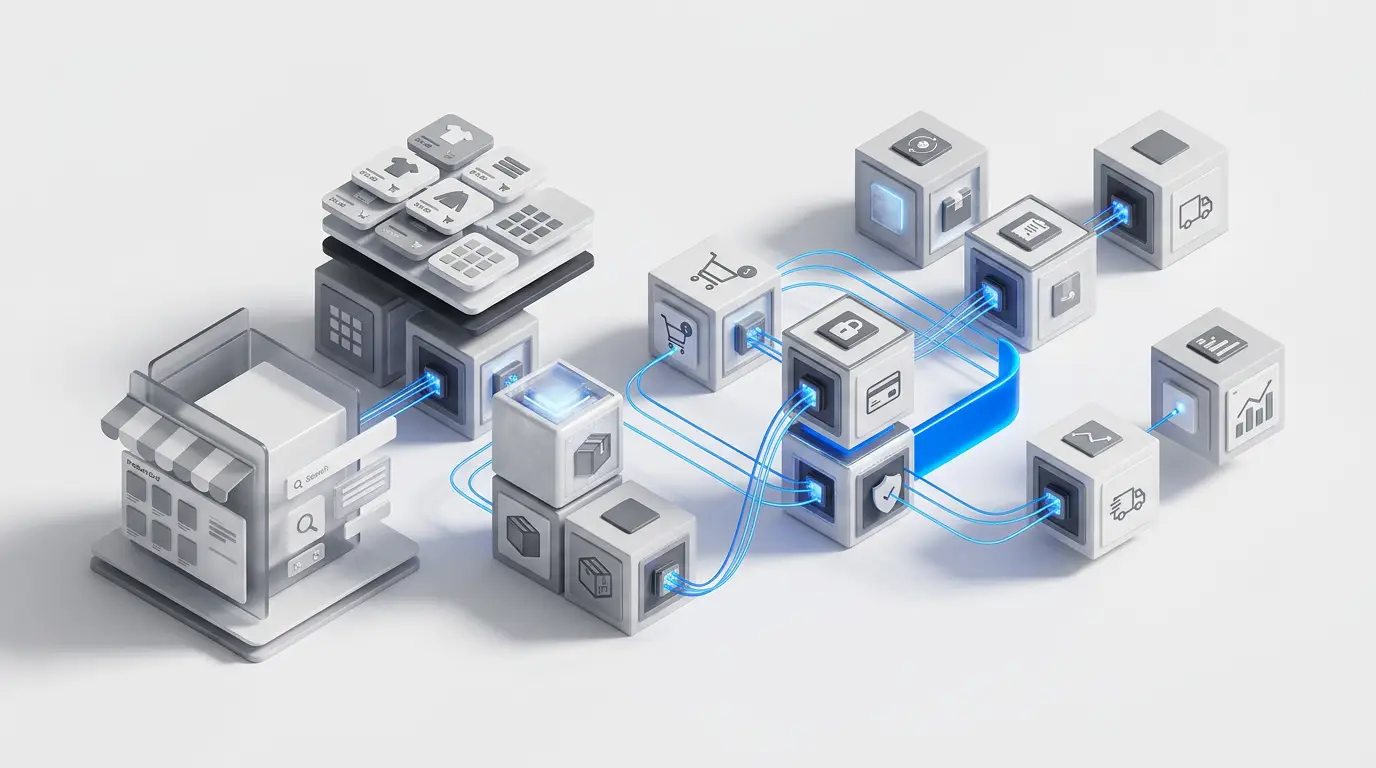
Exact vendor choices vary. The shape repeats. Use the list as a map of what you must own, observe, and contract.
- Search and browse. Query models, ranking, and merchandising signals. Often a dedicated engine behind stable reads.
- Catalog and PIM. Attributes, media, relationships, and channel-specific completeness rules.
- Pricing and promotions. Rules that must render consistently on PDP, cart, and invoices.
- Cart and checkout. Session state, tax, shipping quotes, fraud checks, and PCI scope decisions at boundaries.
- Orders and OMS. Allocation, fulfillment routing, cancellations, and customer-visible status.
- Identity and consent. Login, SSO, privacy preferences, and auditable marketing consent where regulations apply.
- Content. Editorial pages, rich storytelling, and reusable modules alongside product-aware components.
- Analytics and experimentation. Event pipelines that respect consent and do not double-count revenue across sessions and devices.
Many of these are SaaS products. MACH-aligned operations still apply: external release calendars are variables you monitor like internal deploys.
Commerce-specific trade-offs beside a unified suite
Use the table to scan what changes when you move from an all-in-one stack toward composed services. It is a simplification; hybrid estates are common.
| Concern | Unified suite or monolith (typical) | Composed MACH-style graph |
|---|---|---|
| Buying motion | One vendor negotiation, shared roadmap assumptions | Multiple contracts; clearer fit per domain, more legal and security review surface |
| Integration cost | Often embedded in licensing and professional services | Explicit integration teams, CI/CD for contracts, observability budget |
| Change speed | Platform releases coordinate features | Independent roadmaps; your compatibility policy becomes the governor |
| Data consistency | Easier single-model assumptions inside the vendor boundary | Eventual consistency and idempotency decisions are unavoidable at seams |
| Peak readiness | Scale the bundle; sometimes pay for unused parts | Targeted scaling; risk of tail latency if synchronous chains are long |
Neither column implies maturity by default. A unified suite can still constrain you with slow releases. A composed stack without governance can outpace your ability to keep prices and stock truthful.
When a suite-first or monolith path still makes sense
MACH is a fit question, not a label of virtue.
- Small team, one channel, few integrations. A single deployable can be simpler to reason about than a graph you cannot staff.
- Regulated workflows with a dominant vendor. Some B2B contracts assume a known ERP and fixed settlement paths; you may still compose at the storefront without rewiring the ledger on day one.
- Unclear domain boundaries. If PIM versus catalog versus merchandising ownership is unsettled, drawing service lines early produces organizational friction without faster delivery.
If you pursue composition, pilot a vertical slice (see the adoption playbook in related reading). Production behavior under retries, dead-letter queues, and vendor incidents matters more than a tidy diagram alone.
Where to go next
Start from the shared vocabulary in the primer linked above, then compare monolith versus composed trade-offs in related reading. For content versus commerce separation and operational detail on contracts, follow the headless CMS and advantages articles in the same list. MACH Architecture groups those threads into one catalog so teams can align before they commit to a vendor map.