On this page
Manufacturing teams often run product and pricing workflows inside tightly coupled systems that were built for stability, not rapid change.
MACH, which stands for Microservices, API-first, Cloud-native, and Headless, helps teams modernize those workflows in phases so product data quality and pricing agility improve without a high-risk full replacement.
Manufacturers usually manage thousands of SKUs, regional price rules, contract terms, and channel-specific assortments at the same time. In many legacy stacks, those concerns are coupled in one system, so a change in product structure can slow pricing updates, and a pricing rule change can trigger broad regression risk.
This article explains where MACH Architecture helps most in product and pricing workflows, which operating changes it requires, and how to phase adoption to reduce delivery and revenue risk.
Why product and pricing workflows break down in legacy stacks
In a legacy monolith, product records, pricing logic, and channel publishing often share one release process and one data model. That shape can work for years, but it becomes harder to sustain when teams add more channels, partner portals, or regional rules.
Common friction points include:
- Shared release dependency: Product and pricing teams wait on the same deployment window, even for low-risk configuration changes.
- Model rigidity: Extending product attributes for one business unit can require schema work that affects unrelated teams.
- Pricing opacity: Rules are implemented in code paths that are difficult for non-engineering teams to inspect.
- Slow channel onboarding: Publishing to a new channel requires adaptation inside a tightly coupled rendering or integration layer.
Where MACH creates leverage
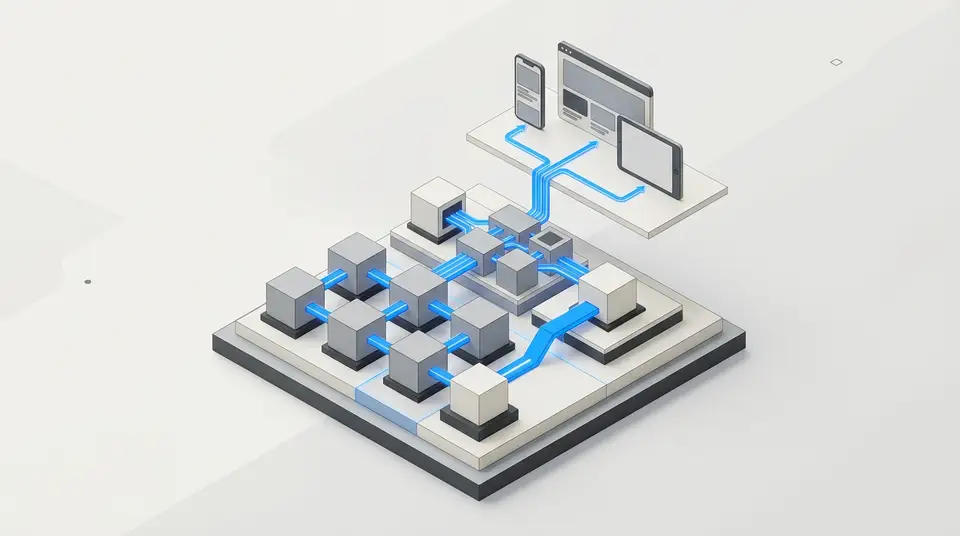
MACH helps when manufacturers need to separate ownership and release cadence across catalog and pricing domains, while still keeping end-to-end consistency.
Use the table below to map each MACH pillar to practical workflow impact.
| Pillar | Workflow impact for manufacturers |
|---|---|
| Microservices | Product information, pricing, promotions, and channel syndication can be split into bounded services so teams change one area without redeploying all commerce logic. |
| API-first | Teams define clear contracts for product reads, price calculation, and publish events, reducing hidden dependencies and making integrations testable earlier. |
| Cloud-native | Compute for expensive pricing recalculations can scale independently from catalog editing workloads, which improves resilience during demand peaks. |
| Headless | Channel experiences (dealer portal, distributor storefront, direct web shop) consume shared product and price services while keeping presentation-specific needs isolated. |
A practical target operating model
Modernization succeeds when technical boundaries are matched with ownership boundaries. A useful baseline model is:
- Product domain service: Owns taxonomy, attributes, lifecycle states, and enrichment.
- Pricing domain service: Owns base prices, account-specific rules, and effective-dating logic.
- Publication and syndication service: Owns outbound mappings to channels and partners.
- Integration platform team: Owns shared concerns such as auth, observability, and contract governance.
In this model, teams collaborate through explicit API contracts and events instead of ad hoc shared tables. That reduces hidden coupling and makes ownership clearer during incidents.
Product and pricing workflow patterns that scale better
Use these patterns to avoid recreating a distributed monolith:
- Separate authoring from serving. Keep editorial product updates and runtime product reads in different paths so read traffic does not block merchandising work.
- Version pricing policies explicitly. Treat rules as versioned artifacts with review and rollback, not only as inline code changes.
- Design for idempotent updates. Build ingestion and synchronization with idempotent behavior so retries do not corrupt product or price state.
- Use event backpressure controls. Add queue and consumer protections for backpressure during bulk catalog imports.
- Define degradation paths. If one dependency is degraded, return last-known-valid price or channel fallback rules based on business policy.
Sequencing a lower-risk modernization
Most manufacturers should not migrate all product and pricing capabilities at once. A phased sequence is usually safer:
- Stabilize interfaces first. Document and publish core product and pricing APIs around the existing system before extracting services.
- Extract one high-friction workflow. Choose a slice such as contract pricing for a single region where delay currently hurts margin or sales cycles.
- Run dual-read validation. Compare outputs between legacy and new services to detect rule or data drift before full cutover.
- Cut over by channel or account segment. Move traffic in controlled cohorts and track conversion, margin, and exception rates.
- Retire legacy paths intentionally. Remove old integration routes and governance exceptions to prevent parallel complexity from becoming permanent.
KPIs that indicate meaningful progress
Track a small, decision-relevant set of indicators instead of a long metrics backlog:
| KPI | Why it matters |
|---|---|
| Price update lead time | Shows whether pricing agility is improving from request to production availability. |
| Product publish success rate | Indicates catalog workflow reliability across channels and partner destinations. |
| Rule-change incident rate | Reveals whether pricing changes are safer as services and governance mature. |
| Channel onboarding time | Measures whether composable interfaces are reducing integration effort for new routes to market. |
Common implementation risks
Three failure modes are frequent in manufacturer programs:
- Boundary confusion: Services are extracted without clear ownership, so cross-team coordination cost stays high.
- Contract drift: Teams change response shapes without version strategy, creating downstream breakage.
- Platform debt: Missing observability and release guardrails make incident response slower in a more distributed environment.
These risks are manageable, but they need explicit governance, not only architecture diagrams.
Summary
For manufacturers, MACH is most valuable when it modernizes product and pricing workflows around clear ownership and stable interfaces. The goal is not decomposition for its own sake. The goal is faster, safer product and pricing change across channels, with operational controls that keep quality and margin outcomes predictable.