On this page
Grocery commerce runs on narrow timing windows. Price changes, substitutions, fulfillment promises, and promotions all move while shoppers are active, so even small delays can affect conversion and trust.
Headless commerce can help by separating the customer experience from core commerce services. That flexibility only pays off when teams design for peak load behavior, clear service boundaries, and practical fallbacks during seasonal stress.
Why grocery pressures headless systems differently
Grocery has the usual digital commerce requirements, but it also adds rapid inventory shifts, frequent promotions, and strict delivery windows. A shopper is often buying mixed baskets (fresh, frozen, household) with different handling constraints and variable availability by store or dark warehouse.
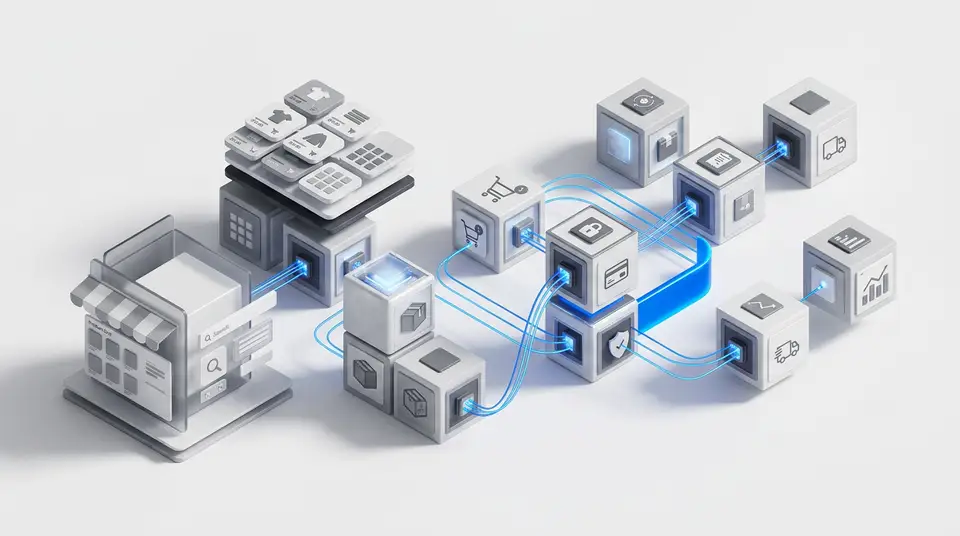
In this context, headless commerce means the presentation layer can evolve independently, while core capabilities remain behind stable APIs. Inside a broader MACH approach, that separation lets teams improve category pages, search journeys, and checkout flows without blocking on one shared release train.
The trade-off is operational. You gain flexibility in channels, but you also own more integration behavior under stress. Grocery teams usually see this first during holidays, weather events, and pay-cycle peaks, when request volume and operational variance rise at the same time.
Where speed matters most in grocery journeys
Use the table below to focus engineering effort on the requests that most influence conversion and customer confidence.
| Journey point | Why it matters | What usually protects speed |
|---|---|---|
| Search and browse | Slow category and search pages reduce basket starts, especially on mobile. | Edge caching for semi-static content, controlled personalization, and strict latency budgets for search APIs. |
| Product detail and availability | Shoppers abandon quickly when stock status is stale or inconsistent. | Short-lived cache policies, clear “last updated” semantics, and graceful fallback when inventory sources lag. |
| Cart and pricing | Grocery baskets can include many line items and promotion combinations. | Deterministic pricing services, bounded synchronous calls, and fast-path responses for common promotion logic. |
| Checkout and slot booking | Delivery windows and payment are high-trust moments where errors are costly. | Minimal critical path, idempotent payment/booking operations, and clear retry behavior. |
A practical pattern is to keep critical checkout dependencies shallow, then move non-blocking enrichments (recommendations, secondary content modules) to asynchronous updates. This reduces exposure to tail latency in revenue-critical paths.
Designing for seasonal and event-driven peaks
Grocery demand spikes are not only holiday-driven. Heat waves, storms, school returns, and local events can generate abrupt, regional traffic bursts. Headless architecture supports these conditions when capacity planning is tied to business events, not only monthly averages.
Capacity and dependency planning
Treat peak readiness as an explicit checklist:
- Critical-path mapping: Identify which services must succeed for basket creation, checkout, and fulfillment slot confirmation.
- Load envelopes: Define expected and worst-case requests per second for each dependency, including external SaaS tools.
- Degradation rules: Decide what can fail soft (for example related products) versus what must fail loud with customer-safe messaging.
- Regional controls: Use routing and traffic shaping so one region’s surge does not exhaust global shared capacity.
Failure behavior under pressure
When peaks arrive, incidents often come from coordination errors rather than one dramatic outage. Repeated retries can overload a dependency, stale inventory can trigger substitution confusion, and delayed event processing can create mismatch between storefront promises and fulfillment reality.
Controls that usually help:
- Timeout and retry discipline: Keep retries bounded and aligned with idempotent operations.
- Queue backpressure management: Monitor lag and processing age so asynchronous updates do not silently drift.
- Dependency isolation: Apply bulkheads and circuit breaking around high-variance integrations.
- Runbooks by journey: Organize response procedures around customer outcomes, not only service ownership boundaries.
Grocery-specific data and content considerations
Headless grocery experiences depend on consistent data contracts across catalog, pricing, inventory, and fulfillment domains. Even small semantic drift can break customer expectations at scale.
Use the table below to align ownership and reduce ambiguity.
| Domain | Primary truth source | Common risk | Mitigation |
|---|---|---|---|
| Catalog and media | CMS plus product information services | Inconsistent taxonomy and delayed media updates across channels | Versioned schemas, validation gates, and publish sequencing rules |
| Pricing and promotions | Pricing engine and promotion service | Conflicting promotion outcomes across web, app, and in-store contexts | Shared promotion policy tests and deterministic calculation order |
| Inventory and availability | Near-real-time inventory feeds by location | Overselling due to stale cache or delayed feed updates | Short cache lifetimes, freshness indicators, and guarded fallback states |
| Fulfillment slots | Slot orchestration and capacity service | Slot double-booking during retry storms | Idempotency keys, reservation expiry controls, and conflict-safe writes |
For mixed business and technical teams, this ownership map is often more useful than a generic architecture diagram. It shows where accountability lives when incidents occur.
A phased rollout model for grocery teams
Headless programs in grocery work better when scope follows customer value and operational readiness.
- Stabilize core contracts. Establish reliable API contracts for catalog, pricing, inventory, cart, and checkout.
- Modernize high-impact surfaces. Upgrade search/listing/product pages and mobile web performance before broad channel expansion.
- Harden peak operations. Run load rehearsals, chaos drills, and dependency failover tests tied to known seasonal scenarios.
- Scale channel variants. Add app, kiosk, partner, or regional experiences once shared governance and observability are stable.
This sequence keeps the program decision-relevant for leadership (conversion, retention, incident rate) while keeping engineering work bounded.
Governance, measurement, and business outcomes
Headless grocery success is not measured only by deployment frequency. Teams should combine platform metrics with customer and operations indicators:
- Checkout completion during peak windows
- Page and search latency at p95 and p99
- Inventory mismatch and substitution rate
- Incident recovery time for revenue-critical journeys
- Speed of merchandising updates across channels
In MACH Architecture programs, this balanced view helps avoid a common failure mode where channel flexibility improves but reliability work lags behind.
Summary
Headless commerce gives grocery retailers a strong way to separate channel experience from core commerce logic, which can improve speed of change and support multi-channel growth. The model is most effective when teams pair that flexibility with rigorous peak planning, dependency controls, and explicit ownership of data contracts. If those operational foundations are in place, seasonal traffic becomes a managed engineering challenge rather than a recurring business risk.