On this page
This article is an orientation guide. If you are evaluating composable platforms, restructuring a commerce or content stack, or aligning engineering and leadership around one mental model, you need a shared way to discuss trade-offs without relying only on vendor decks.
MACH stands for Microservices, API-first, Cloud-native, and Headless. On MACH Architecture, treat this guide as the entry path. Use it to orient yourself, then follow related reading when you need definitions, comparisons, playbooks, or production detail.
What this guide is for
Orientation. You will leave with a concise mental model, a sense of who must participate for MACH to work, and a short set of checks that separate funded programs from rebranded slideware.
Sequencing. The catalog on MACH Architecture goes deeper on pillars, monolith comparisons, adoption, and integrations. This page suggests how to read those pieces so you do not start with production contracts before you have named outcomes.
Language for mixed audiences. Architects need seams and failure modes. Leadership needs cost, risk, and time-to-value. Product needs experiment surface. A guide should keep all three on the same diagram without turning into generic “digital transformation” wording.
The idea in one paragraph
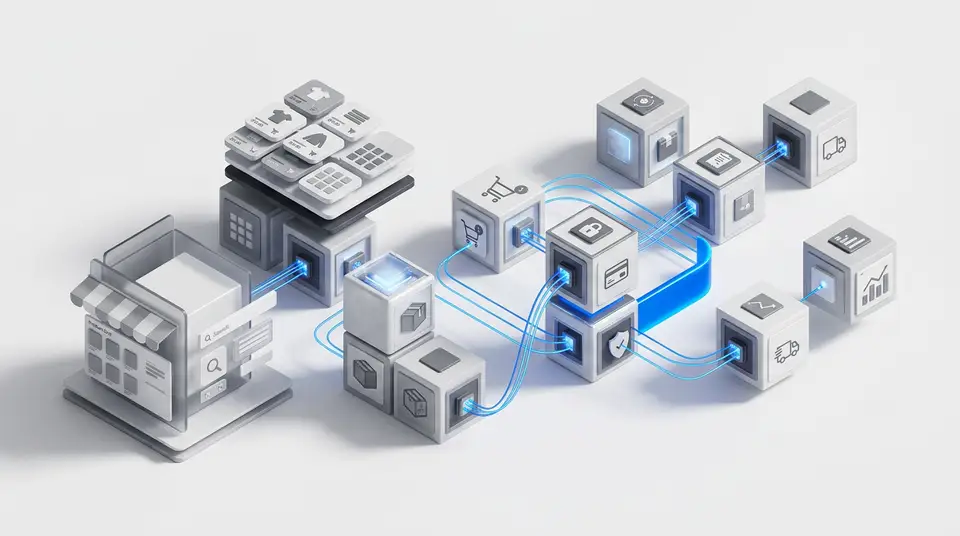
MACH describes how to build platforms when capabilities (cart, pricing, content, search, identity, promotions) should evolve on different schedules. Instead of one deployable that couples everything by default, you compose bounded parts that communicate through published APIs, run with automation and measurable reliability, and often separate authoritative data from channel experience so a storefront, app, and partner channel can diverge without forking the core.
That sentence compresses four commitments. The important part is the assignment of complexity. MACH moves hard problems into integration, contracts, and operations. It does not remove them.
The four commitments at a glance
Use the table for a skim. For definitions, examples, and how the pillars reinforce each other, read the dedicated primer in related reading.
| Commitment | What it asks you to optimize | Where it goes wrong without governance |
|---|---|---|
| Microservices | Bounded contexts you can deploy independently when ownership is clear | Distributed monolith behavior; coordinated releases across “services” that are still one system |
| API-first | Stable consumer contracts, observable change, compatibility discipline | Hidden coupling through shared databases, tight coupling to private internals, “temporary” shortcuts that never leave |
| Cloud-native | Reproducible environments, elasticity, automation, incident readiness | Lift-and-shift hosting without CI/CD, identity, or operational baselines; cost without clarity |
| Headless | Editors and cores stay structured; experiences fetch over APIs | Channel inconsistency, preview gaps, CDN and cache surprises if contracts are weak |
Who must show up for MACH to work
Architecture diagrams hide organizational facts. The table names typical stakeholders and what they must contribute beyond approvals.
| Stakeholder | Primary contribution | Failure signal |
|---|---|---|
| Product and domain leadership | Outcomes, non-goals, customer journeys worth isolating | Roadmap becomes a vendor list; no credible vertical slice |
| Engineering and architecture | Boundaries, API design, performance and resilience patterns | Manual coordination replaces explicit contracts |
| Platform and operations | Identity, observability, environments, CI/CD, security between services | Teams cannot reproduce production; incidents do not trace across boundaries |
| Security and compliance | Data flows, vendor risk, access models early | Late surprises that force rework or block launches |
| Finance and procurement | Realistic funding for integration and long-term SaaS TCO | Expecting cost savings from “splitting the monolith” without budgeting for the integration graph |
Readiness checks before you commit
Honest answers prevent expensive theater. Treat the list as a gate, not a scorecard.
- Outcomes: You can name customer or revenue outcomes that justify more moving parts. “Modernize” is not an outcome.
- Ownership: seams on the diagram have named teams and SLO-grade accountability, not shared buckets.
- Contracts: you plan to version APIs, test compatibility, and deprecate on a clock stakeholders can plan around.
- Operations: you can fund observability, identity, and runbooks for a dependency graph, not only for individual repositories.
- Pace: you need independent lifecycles (B2B rollout trains, seasonal peaks, frequent experiments) enough to merit the cost of composition.
If several checks read as uncertain, start with assessment and a thin pilot. The adoption playbook in related reading is written for that posture.
Suggested reading order on MACH Architecture
Use the table when you are deciding what to open next. It maps common starting points to articles that avoid redundancy.
| If you are trying to… | Start with | Then |
|---|---|---|
| Build shared vocabulary | The primer on what MACH is | Monolith versus MACH trade-offs |
| Choose between a monolith and composable | Monolith versus MACH | Advantages framed for your constraints |
| Plan adoption | The roadmap-to-runtime playbook | Production integrations and contracts |
| Operate in production | Integrations and contracts | Headless CMS detail if content is in scope |
| Anchor commerce context | Composable patterns in ecommerce | Advantages and production articles as needed |
Mistakes that quietly undo good intent
- Pillar shopping: buying “headless” or “microservices” labels without contract and operations discipline.
- Accidental distributed monolith: many repositories, one release fate, hidden shared data.
- Vendor sprawl without data ownership: three systems of record for the same entity and no reconciliation story.
- Experience without platform: storefront work on weak CI/CD and identity foundations that only appear under load.
- Governance theater: architecture reviews that never touch compatibility tests, deprecation policy, or incident rehearsal.
Summary
A useful guide should make the next decision obvious. If your organization can fund explicit seams, disciplined operations, and clear ownership, MACH can reduce the marginal cost of change in the areas you care about. If those foundations are missing, the same diagram becomes expensive brittleness.
Use related reading to go from orientation to comparison, adoption, commerce context, and production behavior. MACH Architecture is most valuable when the reading order matches the work order, not the slide order.