On this page
If your company is evaluating MACH, the useful question is not whether it is modern. The useful question is whether it helps your teams deliver outcomes faster, with clearer ownership and less release friction.
This article explains where MACH creates measurable business value, what organizational conditions make those benefits real, and how to start without a high-risk full rebuild.
Why this matters for your company
Most companies do not adopt architecture patterns for technical elegance. They adopt them because current delivery speed, platform flexibility, or reliability no longer match business goals.
MACH can help when your company faces one or more common bottlenecks:
- Multiple teams are blocked by one shared release train.
- One peak workload forces you to scale the whole platform.
- Launching a new channel takes months of backend coordination.
- A failure in one subsystem spreads across customer journeys.
If those patterns sound familiar, the business case for MACH Architecture becomes concrete.
The benefits your company can expect
Use the table below to map architectural changes to business outcomes.
| MACH capability | What improves for your company | What must be in place |
|---|---|---|
| Independent services | Faster delivery because teams ship within their domain without waiting for unrelated releases. | Clear domain ownership, service boundaries, and release standards. |
| API-first contracts | Faster integration with partners, channels, and internal products; less guesswork between teams. | Contract versioning, compatibility checks, and integration testing. |
| Cloud-native operations | Better scaling during demand peaks and better recovery during incidents. | Strong observability, automated deployment, and capacity planning. |
| Headless delivery | Quicker channel launches and easier experience iteration across web, app, and other touchpoints. | Stable backend contracts and disciplined content or commerce modeling. |
1) Faster delivery with clearer ownership
When architecture mirrors business domains, teams can release changes without editing a single central codebase for every request. This often reduces coordination time, not just build time.
For your company, this means:
- Product teams can prioritize by customer impact, not by shared release windows.
- Engineering leads can reduce cross-team dependency meetings for routine changes.
- Leadership can fund initiatives with better predictability because ownership boundaries are explicit.
The key mechanism is bounded context ownership. Without that, service count can grow while dependency friction stays high.
2) Better scalability and cost alignment
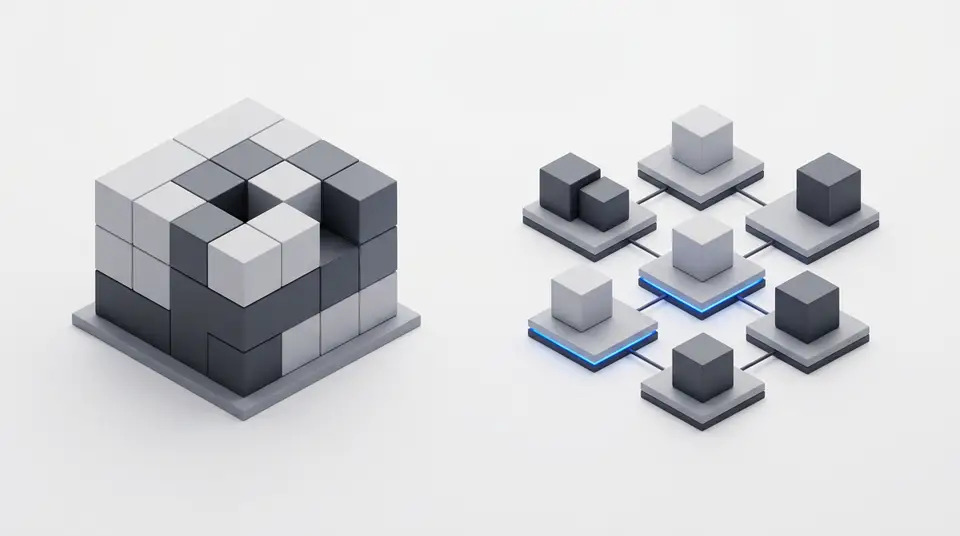
In monolithic systems, one high-traffic flow can force broad infrastructure scaling. With MACH, your company can scale high-demand capabilities independently.
That improves cost alignment in practical ways:
- You allocate resources to actual traffic hotspots.
- You avoid overprovisioning low-demand capabilities.
- You tune performance where revenue impact is highest.
This is not automatic savings. It is better control. You still need strong operational practices and clear service-level targets.
3) Lower risk concentration in production
Business stakeholders usually experience architecture as uptime, incident scope, and recovery speed. One advantage of a well-run MACH setup is smaller blast radius.
When failures stay local, your company can:
- Limit customer impact to specific journeys.
- Restore priority capabilities faster.
- Improve incident communication with clearer responsibility.
The opposite can happen if contracts are weak. Poorly governed services can form a distributed monolith that keeps risk high while increasing operational overhead.
4) Stronger channel flexibility and time to market
When product data and business logic are exposed through stable interfaces, your company can deliver experiences across channels without rebuilding core systems each time.
This is especially relevant when teams need to move quickly across:
- Web storefronts
- Mobile applications
- Partner or marketplace integrations
- Region-specific experiences
Headless patterns do not remove complexity. They relocate it to integration quality and governance, which is usually the right trade when speed across channels is a strategic goal.
When these benefits are most likely to materialize
MACH tends to produce stronger outcomes when your company already has:
- Multiple product or platform teams that ship frequently.
- Growing channel requirements and integration surface area.
- Leadership support for long-term platform investment.
- Willingness to standardize contracts and operational practices.
If your organization is small, single-channel, and early in product-market exploration, a simpler monolith may still be the better short-term decision.
A pragmatic adoption path for your company
Avoid full rewrites as a first step. Start with a high-value vertical slice and validate outcomes.
- Choose one business capability with clear ROI and pain (for example search, checkout, or content delivery).
- Define interface contracts first, including failure and version behavior.
- Run production observability from day one, not as a later phase.
- Measure cycle time, incident scope, and channel delivery speed against a baseline.
- Expand only when results justify the next slice.
This sequence helps your company de-risk adoption while building internal operating maturity.
Final takeaway
Your company benefits from MACH Architecture when architectural independence maps to organizational ownership and business priorities. The payoff is typically faster delivery, more targeted scalability, reduced failure spread, and better channel agility.
The condition is discipline. MACH is not a shortcut around complexity. It is a way to structure complexity so teams can move with more control and clearer economic trade-offs.